# Manual-to-Electric Ball Valve Retrofit: A Complete Engineering Guide from Feasibility to Commissioning
In process industries — oil and gas, chemicals, power generation, water treatment, metallurgy — ball valves are among the most widely deployed shut-off devices. A large installed base, however, still relies on wrench- or worm-gear handwheel operation. Such manual valves cannot be integrated with DCS / PLC systems, cannot enable fast interlocking, remote actuation, or process data acquisition. As plants push toward unattended operation and tighter HSE (Health, Safety, Environment) oversight, retrofitting in-service manual ball valves into electric-actuated units has become a practical, cost-effective path in valve maintenance and modernization.
This guide follows a real "live-piping retrofit" project (Figure 1 shows the site before work began) and walks through the whole chain: feasibility assessment, component selection, an eight-step field installation procedure, safety and acceptance standards, common fault troubleshooting, and lifecycle ROI. It runs about 5,000 words and is written for process engineers, I&C engineers, operations folks, and valve procurement teams.
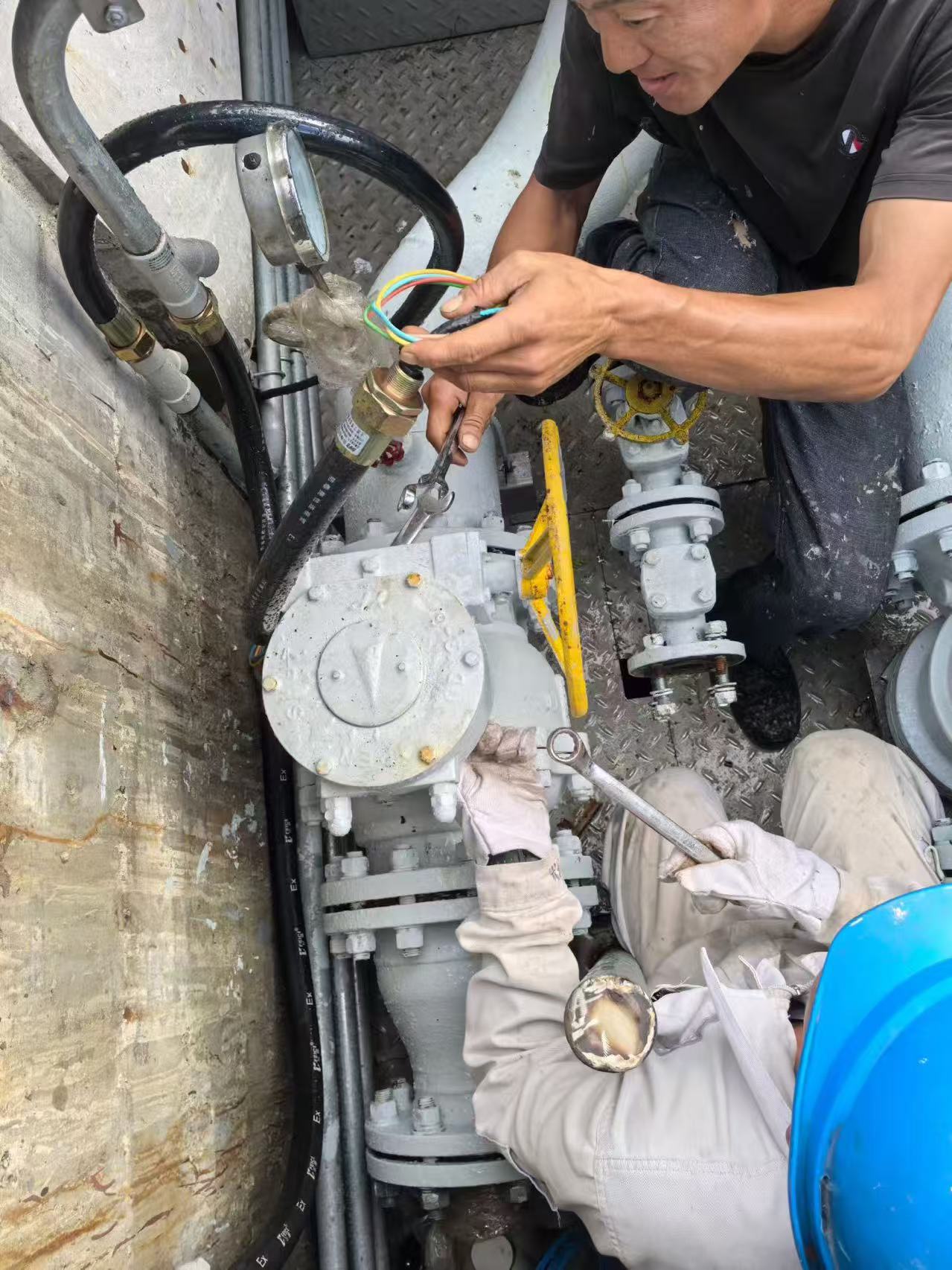 Figure 1: Before the retrofit — workers dismantling a DN80 PN16 manual flanged ball valve to install an electric actuator
## 1. Why More Plants Choose "Manual-to-Electric"
Several practical needs are pushing this trend:
**1) Remote control and system integration.** Modern plants use DCS (Distributed Control System) or PLC (Programmable Logic Controller) platforms for centralized monitoring. A manual valve can only be operated by a person on-site and cannot respond to a control-room command. After the retrofit, the electric actuator accepts standard signals — 4-20 mA, 0-10 V, PROFIBUS / MODBUS / HART — and connects to the control system for remote open/close and proportional positioning.
**2) Interlocking protection and process safety.** In an Emergency Shutdown (ESD) system, valves must close within seconds under fire, leak, over-pressure or over-temperature conditions. Manual valves cannot. A properly configured electric actuator can close in 0.5-5 seconds, dramatically reducing incident losses.
**3) Reduced on-site staffing and better HSE conditions.** For high-temperature, high-pressure, toxic or confined-space operations, on-site valve manipulation is a major personnel hazard. After the retrofit, an operator can complete all valve actions from a control room — eliminating personal exposure and occupational health risk.
**4) Data acquisition and predictive maintenance.** Modern electric actuators embed position feedback, torque monitoring, cycle count, running time and diagnostic code data. These can be uploaded to a cloud platform or Plant Asset Management (PAM) system via industrial IoT gateways, providing the foundation for predictive maintenance — a capability manual valves simply do not offer.
**5) Process stability and product quality.** In food, pharmaceutical and semiconductor operations where cleanliness and consistency are critical, the inherent randomness of manual operation creates flow variability. Electric actuators follow a precise profile, stabilizing process parameters.
## 2. Which Manual Ball Valves Can Be Retrofitted
Not every manual ball valve is a good candidate. A few things need checking before you commit to a retrofit.
**1) Standard valve body construction.** The easiest, lowest-cost retrofits target **flanged-end ball valves** (per GB/T 17241 or ASME B16.5), **threaded-end ball valves** and **welded-end ball valves**. As long as the valve has a standard ISO 5211 mounting pad (a 4-hole or 2-D pattern with defined bolt circle) at the top of the stem, the electric actuator can mount directly. Non-standard stem adapters (older round-nut or threaded-nut designs) require custom-made mounting brackets, raising complexity.
**2) Stem diameter and stem-end profile.** The actuator input coupling must match the valve stem. Common patterns are F03 / F04 / F05 / F07 / F10 / F12 / F14 / F16 (the number is the bolt circle in mm — for example, F05 is 50 mm), double-D, square head, and keyed configurations. Measure stem diameter, across-flats dimensions and bolt-hole geometry before sourcing the bracket.
**3) Nominal diameter and pressure class.** DN15 to DN300 valves are ideal. DN350 and above require very high torque, often necessitating special multi-turn actuators that drive cost up sharply — at which point replacing the entire valve/actuator assembly is more economical.
**4) Operating torque and thrust.** This is the single most important parameter. Refer to the valve manufacturer's datasheet for the maximum torque under the highest pressure differential and select an actuator with a 1.25-1.5× safety factor. If the handwheel feels heavy, or if the ball/seat shows any stickiness, perform offline maintenance or lap the sealing surfaces before sizing the actuator.
**5) Medium and service conditions.** Highly corrosive, flammable, particulate-laden, high-temperature (>200 °C) or low-temperature (<-40 °C) media require matching corrosion-resistant, explosion-proof or temperature-rated actuators and seals. Conventional chemical, water and HVAC services are the easiest retrofits.
**6) Installation space.** Electric actuators occupy more vertical space than handwheels. Above the stem, plan for actuator height + maintenance clearance (typically 350-800 mm). Beside the valve, leave room for power entry, cabling and a local control panel.
## 3. The Core Components of a Retrofit Kit
A manual-to-electric kit comes down to a few main components.
**Part 1 — Electric actuator body.** The core of the retrofit. By control mode, actuators are **on/off** (two-position) or **modulating** (proportional). By output type, they are **quarter-turn** (0-90°), **multi-turn** or **linear**. Ball valves are quarter-turn devices and pair with quarter-turn actuators. Common international brands include ROTORK, AUMA, EMG, Biffi, SIEMENS, ABB, Limitorque. Mature domestic Chinese brands such as Tianjin Bell, Yangzhou Hengchun, Shanghai Mingjing and Baoding Taihang offer comparable performance at lower cost.
**Part 2 — Mounting bracket and coupling.** This is the mechanical bridge between actuator and valve body. A transition bracket is machined to match the valve stem size and shape — the inner bore mates with the stem (interference fit or keyed), and the top flange mates with the actuator base via ISO 5211. Bracket material is usually 304/316 stainless steel or ductile iron for corrosion resistance. If the original valve lacks an ISO 5211 pad, an additional stem extension sleeve is required.
**Part 3 — Control and feedback elements.** Including: limit switches (typically 2-4 groups for open/closed positions and auxiliary signals), torque-overload protection switches, a local control station (LCS), a position transmitter (4-20 mA or potentiometer), and a handwheel declutching mechanism for electric/manual mode changeover.
**Part 4 — Cables, glands and explosion-proof accessories.** Cable glands, three-phase 380 V / single-phase 220 V / DC 24 V power cables, control signal cables, grounding cables, and where required, explosion-proof flexible conduits and junction boxes. In hazardous areas, all accessories must carry the required Ex d (flameproof) or Ex e (increased safety) certification, matched to the actual zone and gas group.
## 4. Eight-Step Field Installation Procedure
The following procedure is illustrated by a real DN80 PN16 manual ball valve retrofit in a chemical plant (Figure 2 shows the finished installation).
Figure 1: Before the retrofit — workers dismantling a DN80 PN16 manual flanged ball valve to install an electric actuator
## 1. Why More Plants Choose "Manual-to-Electric"
Several practical needs are pushing this trend:
**1) Remote control and system integration.** Modern plants use DCS (Distributed Control System) or PLC (Programmable Logic Controller) platforms for centralized monitoring. A manual valve can only be operated by a person on-site and cannot respond to a control-room command. After the retrofit, the electric actuator accepts standard signals — 4-20 mA, 0-10 V, PROFIBUS / MODBUS / HART — and connects to the control system for remote open/close and proportional positioning.
**2) Interlocking protection and process safety.** In an Emergency Shutdown (ESD) system, valves must close within seconds under fire, leak, over-pressure or over-temperature conditions. Manual valves cannot. A properly configured electric actuator can close in 0.5-5 seconds, dramatically reducing incident losses.
**3) Reduced on-site staffing and better HSE conditions.** For high-temperature, high-pressure, toxic or confined-space operations, on-site valve manipulation is a major personnel hazard. After the retrofit, an operator can complete all valve actions from a control room — eliminating personal exposure and occupational health risk.
**4) Data acquisition and predictive maintenance.** Modern electric actuators embed position feedback, torque monitoring, cycle count, running time and diagnostic code data. These can be uploaded to a cloud platform or Plant Asset Management (PAM) system via industrial IoT gateways, providing the foundation for predictive maintenance — a capability manual valves simply do not offer.
**5) Process stability and product quality.** In food, pharmaceutical and semiconductor operations where cleanliness and consistency are critical, the inherent randomness of manual operation creates flow variability. Electric actuators follow a precise profile, stabilizing process parameters.
## 2. Which Manual Ball Valves Can Be Retrofitted
Not every manual ball valve is a good candidate. A few things need checking before you commit to a retrofit.
**1) Standard valve body construction.** The easiest, lowest-cost retrofits target **flanged-end ball valves** (per GB/T 17241 or ASME B16.5), **threaded-end ball valves** and **welded-end ball valves**. As long as the valve has a standard ISO 5211 mounting pad (a 4-hole or 2-D pattern with defined bolt circle) at the top of the stem, the electric actuator can mount directly. Non-standard stem adapters (older round-nut or threaded-nut designs) require custom-made mounting brackets, raising complexity.
**2) Stem diameter and stem-end profile.** The actuator input coupling must match the valve stem. Common patterns are F03 / F04 / F05 / F07 / F10 / F12 / F14 / F16 (the number is the bolt circle in mm — for example, F05 is 50 mm), double-D, square head, and keyed configurations. Measure stem diameter, across-flats dimensions and bolt-hole geometry before sourcing the bracket.
**3) Nominal diameter and pressure class.** DN15 to DN300 valves are ideal. DN350 and above require very high torque, often necessitating special multi-turn actuators that drive cost up sharply — at which point replacing the entire valve/actuator assembly is more economical.
**4) Operating torque and thrust.** This is the single most important parameter. Refer to the valve manufacturer's datasheet for the maximum torque under the highest pressure differential and select an actuator with a 1.25-1.5× safety factor. If the handwheel feels heavy, or if the ball/seat shows any stickiness, perform offline maintenance or lap the sealing surfaces before sizing the actuator.
**5) Medium and service conditions.** Highly corrosive, flammable, particulate-laden, high-temperature (>200 °C) or low-temperature (<-40 °C) media require matching corrosion-resistant, explosion-proof or temperature-rated actuators and seals. Conventional chemical, water and HVAC services are the easiest retrofits.
**6) Installation space.** Electric actuators occupy more vertical space than handwheels. Above the stem, plan for actuator height + maintenance clearance (typically 350-800 mm). Beside the valve, leave room for power entry, cabling and a local control panel.
## 3. The Core Components of a Retrofit Kit
A manual-to-electric kit comes down to a few main components.
**Part 1 — Electric actuator body.** The core of the retrofit. By control mode, actuators are **on/off** (two-position) or **modulating** (proportional). By output type, they are **quarter-turn** (0-90°), **multi-turn** or **linear**. Ball valves are quarter-turn devices and pair with quarter-turn actuators. Common international brands include ROTORK, AUMA, EMG, Biffi, SIEMENS, ABB, Limitorque. Mature domestic Chinese brands such as Tianjin Bell, Yangzhou Hengchun, Shanghai Mingjing and Baoding Taihang offer comparable performance at lower cost.
**Part 2 — Mounting bracket and coupling.** This is the mechanical bridge between actuator and valve body. A transition bracket is machined to match the valve stem size and shape — the inner bore mates with the stem (interference fit or keyed), and the top flange mates with the actuator base via ISO 5211. Bracket material is usually 304/316 stainless steel or ductile iron for corrosion resistance. If the original valve lacks an ISO 5211 pad, an additional stem extension sleeve is required.
**Part 3 — Control and feedback elements.** Including: limit switches (typically 2-4 groups for open/closed positions and auxiliary signals), torque-overload protection switches, a local control station (LCS), a position transmitter (4-20 mA or potentiometer), and a handwheel declutching mechanism for electric/manual mode changeover.
**Part 4 — Cables, glands and explosion-proof accessories.** Cable glands, three-phase 380 V / single-phase 220 V / DC 24 V power cables, control signal cables, grounding cables, and where required, explosion-proof flexible conduits and junction boxes. In hazardous areas, all accessories must carry the required Ex d (flameproof) or Ex e (increased safety) certification, matched to the actual zone and gas group.
## 4. Eight-Step Field Installation Procedure
The following procedure is illustrated by a real DN80 PN16 manual ball valve retrofit in a chemical plant (Figure 2 shows the finished installation).
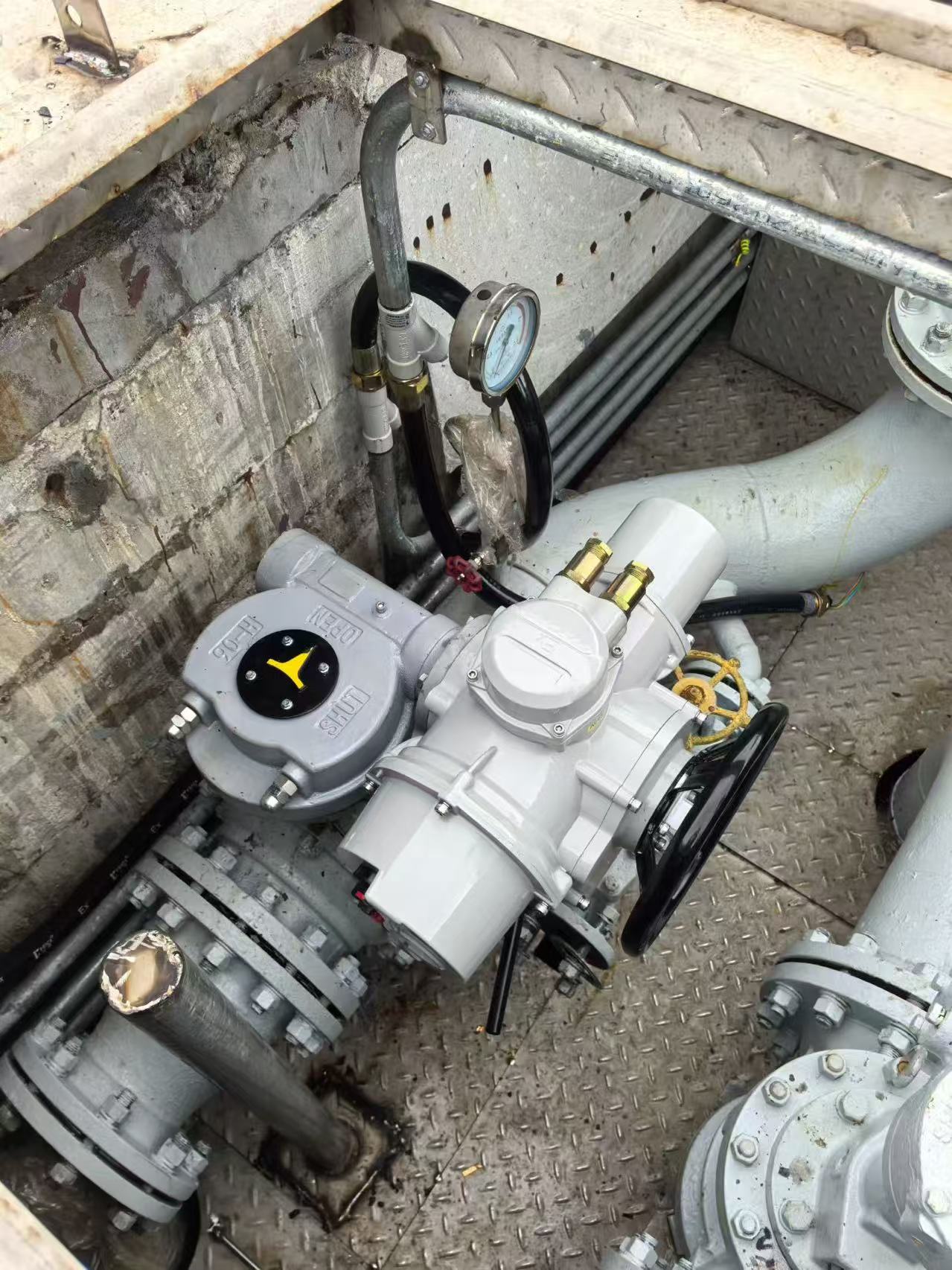 Figure 2: After the retrofit — the electric ball valve with actuator installed, retaining the handwheel for emergency operation and the position indicator
**Step 1: Project approval and design review.** Process, I&C, mechanical and safety teams jointly review the design — actuator specification, control signal, hazardous-area certification, ESD interlocking needs, Factory Acceptance Test (FAT) and Site Acceptance Test (SAT) criteria.
**Step 2: Permit to work and process isolation.** This is the highest-risk stage of any retrofit. Issue hot-work, confined-space and electrical-work permits. Drain and purge the line, perform nitrogen displacement, continuously monitor LEL (<5%) with a combustible gas detector, and confirm zero residual pressure by two-person verification.
**Step 3: Offline valve inspection.** Remove the handwheel assembly and stem nut, inspect stem threads, packing, body sealing surfaces, ball wear, seat O-rings. If the stem is bent, the ball is stuck, or the sealing surface is grooved, repair or replace the parts before mounting the actuator — otherwise the actuator will trip on torque overload.
**Step 4: Measure stem-end geometry.** Caliper-measure stem diameter D, across-flats size, mounting hole positions and depths; use these to machine or source the mounting bracket. Standard ISO 5211 brackets can usually be purchased off the shelf.
**Step 5: Install bracket and coupling.** Slide the bracket and coupling onto the stem and torque-tighten to the stem-material specification — typically 30-80 N·m. After assembly, turn by hand to confirm smooth operation with no binding or abnormal friction.
**Step 6: Mount the electric actuator.** Hoist the actuator into position (use a small manual chain hoist when needed), align with the bracket, and tighten flange bolts in a diagonal cross-pattern. Place the electric/manual changeover lever in the "manual" position; turn the handwheel to bring the valve to the mid-stroke position (about 45°), then switch to "electric".
**Step 7: Power, grounding and signal wiring.** Wire three-phase power (or single-phase + ground), control signals and feedback signals per the electrical drawing. Use a voltage tester and megger to verify insulation (phase-to-phase and phase-to-ground insulation resistance ≥0.5 MΩ) before energizing.
**Step 8: Stroke calibration and acceptance.** This is the most critical step — see Section 5. After commissioning is complete, fill in commissioning records, sign off handover documents, build asset files and update the maintenance ledger.
## 5. Safety and Acceptance Standards
Acceptance criteria should be nailed down before commissioning. Here's what we typically check:
**1) Position repeatability.** For on/off actuators, ten successive open/close cycles must land within ±1° of the target. For modulating actuators, the actual position vs set-point must stay within ±2% of full stroke when tested across the 4-20 mA range.
**2) Operating time.** DN50 and below: 5-10 s; DN50-DN150: 10-30 s; above DN150: 30-60 s. Out-of-range results indicate voltage, phase sequence or actuator sizing issues.
**3) Insulation resistance.** With a 500 V megger, power terminals to ground must read ≥1.0 MΩ; motor windings to ground ≥0.5 MΩ.
**4) Ingress protection.** For outdoor installations, IP65 or higher is normal; washdown or submerged locations require IP67/IP68; dust environments need IP6X. Visually verify glands and seals are properly torqued.
**5) Hazardous-area certification and grounding.** All explosion-proof equipment must carry a nationally-recognized Ex certificate with full nameplate markings. Ground resistance ≤4 Ω, ground conductor cross-section ≥4 mm².
**6) ESD interlock test.** From the control room, send an ESD close command; the actuator must fully close within the specified time (commonly ≤5 s) and emit a "closed" feedback signal.
**7) Integrated run-in.** Run with the upstream/downstream process and equipment for at least 72 hours (168 hours for nuclear-class service). Sign-off requires zero faults, zero leaks and zero abnormal alarms.
One thing to watch: when retrofitting on pipelines carrying flammable media (hydrogen, LPG, light oils, benzenes, etc.), micro-leaks can occur at flanges, threaded joints and cable glands. Continuous combustible-gas monitoring, fire extinguishers on standby, and antistatic wrist straps, antistatic clothing and personal gas detectors are mandatory. Any team member detecting an LEL alarm must halt the work and evacuate immediately.
## 6. Common Fault Cases and Diagnostic Logic
Based on years of retrofit project work, these are the faults we see most often:
**Fault 1: Actuator energized but no movement and no display.** Check in order: ① power supply on the input (measure line voltage); ② fuse condition; ③ phase sequence (some actuators auto-detect, some do not); ④ control signal present (verify DCS output); ⑤ motor jammed (try manual override with the declutch lever).
**Fault 2: Actuator stops mid-stroke and reports "torque overload".** Check in order: ① foreign object jammed inside the valve (weld slag, seal fragment on the close side); ② medium pressure above design; ③ torque protection threshold set too low; ④ mechanical misalignment between actuator and valve; ⑤ bent stem.
**Fault 3: Actuator hunts and cannot settle on a set position.** Common in modulating actuators. Check in order: ① control signal stability (use a multimeter — is the current jittering?); ② feedback signal line interference (use shielded cable, properly grounded); ③ PID parameters (proportional gain, integral time, derivative time); ④ actuator dead-band.
**Fault 4: Valve does not fully close — internal leakage.** Check in order: ① real closed position reached (look at the position arrow vs housing marker); ② soft-seated ball valve — seat wear; ③ hard-seated ball valve — particle embedment on sealing face; ④ packing gland too tight — stem torque is excessive and the valve cannot fully close.
**Fault 5: Corrosion and premature failure.** In coastal or aggressive chemical environments, selecting the wrong material can rust the housing through, fracture fasteners and embrittle seals within months. Specify 316 stainless-steel housings or reinforced polyester coatings.
## 7. Cost Structure and Return on Investment
The retrofit cost has three components:
**1) Equipment procurement — about 60%-75% of total.** Includes the electric actuator, mounting bracket, control elements, cables, and explosion-proof glands. For a DN80 ball valve paired with a leading domestic Chinese on/off actuator, the typical tax-inclusive price is roughly CNY 3,500-7,500; modulating actuators or imported brands double the figure.
**2) Installation and commissioning labor — about 15%-25%.** Includes process isolation, valve offline maintenance, mechanical installation, electrical wiring, signal commissioning and integrated testing. An experienced team (2-3 people) typically spends 1-3 days per valve, at CNY 1,500-4,500 per valve in labor cost.
**3) Testing, certification and spare parts — about 5%-15%.** Includes explosion-proof inspection, insulation testing, commissioning instruments, spare parts and documentation.
**ROI Analysis:** In a medium-sized chemical plant, taking a DN100 electric ball valve retrofit at CNY 9,000 as an example:
- Before: 1-2 operators make ~600 on-site actuations per year. At an average operator cost of CNY 150,000/year plus the time lost walking to and from the site, the annual labor cost is well above CNY 20,000;
- After: integrated into the DCS, an operator performs all actions from the control room, dropping annual labor cost below CNY 5,000;
- Additionally, the ESD interlocking and data acquisition bring an estimated CNY 50,000-150,000 per year of avoided incident cost;
- The combined payback period is typically 8-14 months — the numbers work.
Retrofitting also costs 40%-60% less than replacing the entire electric ball valve, because the original valve body — the main pressure-bearing component, with 15-25 years of design life — stays in place. Only the actuator portion is renewed.
## 8. Quick Selection Reference Table
| Original Valve Specs | Retrofit Difficulty | Recommended Actuator | Key Considerations |
|----------------------|---------------------|---------------------|--------------------|
| DN15-DN50 PN16 flanged | ★☆☆☆☆ | Basic on/off, IP65, AC220V | Verify ISO 5211 stem pad |
| DN50-DN150 PN16-PN40 | ★★☆☆☆ | Mid-torque, IP65/IP67, AC380V or DC24V | Torque safety factor ≥1.3 |
| DN150-DN300 PN16-PN40 | ★★★☆☆ | High-torque with ESD interface | Verify maintenance space + bracket machining |
| DN350 and above | ★★★★☆ | Multi-turn or special high-torque | Total cost high — consider full replacement |
| Flammable media | +★ | Flameproof Ex d IIB T4 or above | Explosion-proof glands + flexible conduit |
| Strongly corrosive media | +★ | Stainless or PTFE-lined actuator | Material certificate vs medium compatibility |
| High/low-temperature | +★ | Heat-sink or low-temp grease version | Outside actuator range — special order |
## 9. Cases Where Retrofit Is Not Advisable
A few situations call for buying a new electric ball valve instead of retrofitting:
- The valve body has exceeded its design service life (typically 15-20 years), with multiple seal repairs; further retrofit is uneconomical;
- The valve body is non-standard and no matching bracket standard part is available;
- Operators, media and pressure are simultaneously in a dangerous regime during the maintenance window;
- A total-cost comparison shows the actuator cost exceeding 80% of the residual value of the original valve — economics erode;
- The end user requires original factory warranty, but a retrofit voids the original sealing integrity.
## 10. Closing Thoughts
Retrofitting manual ball valves into electric ball valves is, at its core, about keeping the pressure-bearing valve body in place while adding control, remote operation, condition monitoring and predictive maintenance on top. The original valve body still has years of service life left — there's no need to replace the whole assembly when only the actuator part needs upgrading. That's also why retrofitting costs 40%-60% less than buying a complete new electric ball valve.
The valve-retrofit market has been growing at 8%-12% per year. For anyone in valve manufacturing, retrofit services, or operations, getting comfortable with the full chain — feasibility, selection, installation, acceptance, ROI — is what it takes to do well in this space.
For plant teams: during each major turnaround, do a quick audit of which manual valves are worth retrofitting, rank them by economics and safety impact, and spread the work over a three-year cycle. That's more practical than trying to do everything at once.
## About the Author
This article was put together by the technical team at Wuxi Quankong Valve & Fluid Control Co., Ltd. (QUAN). We make industrial valves and fluid automation equipment — control valves, ball valves, butterfly valves, gate valves, special valves — and also handle valve electrification upgrades, intelligent retrofits, and remote operations support. For technical questions or retrofit inquiries: [email protected].
Figure 2: After the retrofit — the electric ball valve with actuator installed, retaining the handwheel for emergency operation and the position indicator
**Step 1: Project approval and design review.** Process, I&C, mechanical and safety teams jointly review the design — actuator specification, control signal, hazardous-area certification, ESD interlocking needs, Factory Acceptance Test (FAT) and Site Acceptance Test (SAT) criteria.
**Step 2: Permit to work and process isolation.** This is the highest-risk stage of any retrofit. Issue hot-work, confined-space and electrical-work permits. Drain and purge the line, perform nitrogen displacement, continuously monitor LEL (<5%) with a combustible gas detector, and confirm zero residual pressure by two-person verification.
**Step 3: Offline valve inspection.** Remove the handwheel assembly and stem nut, inspect stem threads, packing, body sealing surfaces, ball wear, seat O-rings. If the stem is bent, the ball is stuck, or the sealing surface is grooved, repair or replace the parts before mounting the actuator — otherwise the actuator will trip on torque overload.
**Step 4: Measure stem-end geometry.** Caliper-measure stem diameter D, across-flats size, mounting hole positions and depths; use these to machine or source the mounting bracket. Standard ISO 5211 brackets can usually be purchased off the shelf.
**Step 5: Install bracket and coupling.** Slide the bracket and coupling onto the stem and torque-tighten to the stem-material specification — typically 30-80 N·m. After assembly, turn by hand to confirm smooth operation with no binding or abnormal friction.
**Step 6: Mount the electric actuator.** Hoist the actuator into position (use a small manual chain hoist when needed), align with the bracket, and tighten flange bolts in a diagonal cross-pattern. Place the electric/manual changeover lever in the "manual" position; turn the handwheel to bring the valve to the mid-stroke position (about 45°), then switch to "electric".
**Step 7: Power, grounding and signal wiring.** Wire three-phase power (or single-phase + ground), control signals and feedback signals per the electrical drawing. Use a voltage tester and megger to verify insulation (phase-to-phase and phase-to-ground insulation resistance ≥0.5 MΩ) before energizing.
**Step 8: Stroke calibration and acceptance.** This is the most critical step — see Section 5. After commissioning is complete, fill in commissioning records, sign off handover documents, build asset files and update the maintenance ledger.
## 5. Safety and Acceptance Standards
Acceptance criteria should be nailed down before commissioning. Here's what we typically check:
**1) Position repeatability.** For on/off actuators, ten successive open/close cycles must land within ±1° of the target. For modulating actuators, the actual position vs set-point must stay within ±2% of full stroke when tested across the 4-20 mA range.
**2) Operating time.** DN50 and below: 5-10 s; DN50-DN150: 10-30 s; above DN150: 30-60 s. Out-of-range results indicate voltage, phase sequence or actuator sizing issues.
**3) Insulation resistance.** With a 500 V megger, power terminals to ground must read ≥1.0 MΩ; motor windings to ground ≥0.5 MΩ.
**4) Ingress protection.** For outdoor installations, IP65 or higher is normal; washdown or submerged locations require IP67/IP68; dust environments need IP6X. Visually verify glands and seals are properly torqued.
**5) Hazardous-area certification and grounding.** All explosion-proof equipment must carry a nationally-recognized Ex certificate with full nameplate markings. Ground resistance ≤4 Ω, ground conductor cross-section ≥4 mm².
**6) ESD interlock test.** From the control room, send an ESD close command; the actuator must fully close within the specified time (commonly ≤5 s) and emit a "closed" feedback signal.
**7) Integrated run-in.** Run with the upstream/downstream process and equipment for at least 72 hours (168 hours for nuclear-class service). Sign-off requires zero faults, zero leaks and zero abnormal alarms.
One thing to watch: when retrofitting on pipelines carrying flammable media (hydrogen, LPG, light oils, benzenes, etc.), micro-leaks can occur at flanges, threaded joints and cable glands. Continuous combustible-gas monitoring, fire extinguishers on standby, and antistatic wrist straps, antistatic clothing and personal gas detectors are mandatory. Any team member detecting an LEL alarm must halt the work and evacuate immediately.
## 6. Common Fault Cases and Diagnostic Logic
Based on years of retrofit project work, these are the faults we see most often:
**Fault 1: Actuator energized but no movement and no display.** Check in order: ① power supply on the input (measure line voltage); ② fuse condition; ③ phase sequence (some actuators auto-detect, some do not); ④ control signal present (verify DCS output); ⑤ motor jammed (try manual override with the declutch lever).
**Fault 2: Actuator stops mid-stroke and reports "torque overload".** Check in order: ① foreign object jammed inside the valve (weld slag, seal fragment on the close side); ② medium pressure above design; ③ torque protection threshold set too low; ④ mechanical misalignment between actuator and valve; ⑤ bent stem.
**Fault 3: Actuator hunts and cannot settle on a set position.** Common in modulating actuators. Check in order: ① control signal stability (use a multimeter — is the current jittering?); ② feedback signal line interference (use shielded cable, properly grounded); ③ PID parameters (proportional gain, integral time, derivative time); ④ actuator dead-band.
**Fault 4: Valve does not fully close — internal leakage.** Check in order: ① real closed position reached (look at the position arrow vs housing marker); ② soft-seated ball valve — seat wear; ③ hard-seated ball valve — particle embedment on sealing face; ④ packing gland too tight — stem torque is excessive and the valve cannot fully close.
**Fault 5: Corrosion and premature failure.** In coastal or aggressive chemical environments, selecting the wrong material can rust the housing through, fracture fasteners and embrittle seals within months. Specify 316 stainless-steel housings or reinforced polyester coatings.
## 7. Cost Structure and Return on Investment
The retrofit cost has three components:
**1) Equipment procurement — about 60%-75% of total.** Includes the electric actuator, mounting bracket, control elements, cables, and explosion-proof glands. For a DN80 ball valve paired with a leading domestic Chinese on/off actuator, the typical tax-inclusive price is roughly CNY 3,500-7,500; modulating actuators or imported brands double the figure.
**2) Installation and commissioning labor — about 15%-25%.** Includes process isolation, valve offline maintenance, mechanical installation, electrical wiring, signal commissioning and integrated testing. An experienced team (2-3 people) typically spends 1-3 days per valve, at CNY 1,500-4,500 per valve in labor cost.
**3) Testing, certification and spare parts — about 5%-15%.** Includes explosion-proof inspection, insulation testing, commissioning instruments, spare parts and documentation.
**ROI Analysis:** In a medium-sized chemical plant, taking a DN100 electric ball valve retrofit at CNY 9,000 as an example:
- Before: 1-2 operators make ~600 on-site actuations per year. At an average operator cost of CNY 150,000/year plus the time lost walking to and from the site, the annual labor cost is well above CNY 20,000;
- After: integrated into the DCS, an operator performs all actions from the control room, dropping annual labor cost below CNY 5,000;
- Additionally, the ESD interlocking and data acquisition bring an estimated CNY 50,000-150,000 per year of avoided incident cost;
- The combined payback period is typically 8-14 months — the numbers work.
Retrofitting also costs 40%-60% less than replacing the entire electric ball valve, because the original valve body — the main pressure-bearing component, with 15-25 years of design life — stays in place. Only the actuator portion is renewed.
## 8. Quick Selection Reference Table
| Original Valve Specs | Retrofit Difficulty | Recommended Actuator | Key Considerations |
|----------------------|---------------------|---------------------|--------------------|
| DN15-DN50 PN16 flanged | ★☆☆☆☆ | Basic on/off, IP65, AC220V | Verify ISO 5211 stem pad |
| DN50-DN150 PN16-PN40 | ★★☆☆☆ | Mid-torque, IP65/IP67, AC380V or DC24V | Torque safety factor ≥1.3 |
| DN150-DN300 PN16-PN40 | ★★★☆☆ | High-torque with ESD interface | Verify maintenance space + bracket machining |
| DN350 and above | ★★★★☆ | Multi-turn or special high-torque | Total cost high — consider full replacement |
| Flammable media | +★ | Flameproof Ex d IIB T4 or above | Explosion-proof glands + flexible conduit |
| Strongly corrosive media | +★ | Stainless or PTFE-lined actuator | Material certificate vs medium compatibility |
| High/low-temperature | +★ | Heat-sink or low-temp grease version | Outside actuator range — special order |
## 9. Cases Where Retrofit Is Not Advisable
A few situations call for buying a new electric ball valve instead of retrofitting:
- The valve body has exceeded its design service life (typically 15-20 years), with multiple seal repairs; further retrofit is uneconomical;
- The valve body is non-standard and no matching bracket standard part is available;
- Operators, media and pressure are simultaneously in a dangerous regime during the maintenance window;
- A total-cost comparison shows the actuator cost exceeding 80% of the residual value of the original valve — economics erode;
- The end user requires original factory warranty, but a retrofit voids the original sealing integrity.
## 10. Closing Thoughts
Retrofitting manual ball valves into electric ball valves is, at its core, about keeping the pressure-bearing valve body in place while adding control, remote operation, condition monitoring and predictive maintenance on top. The original valve body still has years of service life left — there's no need to replace the whole assembly when only the actuator part needs upgrading. That's also why retrofitting costs 40%-60% less than buying a complete new electric ball valve.
The valve-retrofit market has been growing at 8%-12% per year. For anyone in valve manufacturing, retrofit services, or operations, getting comfortable with the full chain — feasibility, selection, installation, acceptance, ROI — is what it takes to do well in this space.
For plant teams: during each major turnaround, do a quick audit of which manual valves are worth retrofitting, rank them by economics and safety impact, and spread the work over a three-year cycle. That's more practical than trying to do everything at once.
## About the Author
This article was put together by the technical team at Wuxi Quankong Valve & Fluid Control Co., Ltd. (QUAN). We make industrial valves and fluid automation equipment — control valves, ball valves, butterfly valves, gate valves, special valves — and also handle valve electrification upgrades, intelligent retrofits, and remote operations support. For technical questions or retrofit inquiries: [email protected].
Figure 1: Before the retrofit — workers dismantling a DN80 PN16 manual flanged ball valve to install an electric actuatorFigure 2: After the retrofit — the electric ball valve with actuator installed, retaining the handwheel for emergency operation and the position indicator
# 手动球阀改造为电动球阀:从可行性评估到现场调试的完整工程指南
在石油、化工、电力、水务、冶金等流程工业里,球阀是使用范围最广的截断类阀门之一。但仍有大量在役的手动球阀依靠人工扳手或蜗轮蜗杆手轮操作,既无法接入 DCS / PLC 控制系统,也难以实现快速联锁、远程启闭与过程数据采集。工厂对无人值守和 HSE 管理的要求越来越高,把存量手动球阀改成电动球阀,在阀门运维和改造这一块算是一条性价比很高的路子。
这篇文章以一个真实的"在役管道带压改造"项目为线索(图 1 是拆装前的手动球阀现场),把手动球阀改电动球阀的工程链条从头走一遍:可行性评估、关键组件选型、八步标准施工、安全规范与验收、常见故障排查、全生命周期投资回报。全文约 5000 字,搞工艺的、搞仪表自控的、搞运维的和采购阀门的都可以看看。
图 1:改造前现场——工人正在拆装 DN80 PN16 手动法兰球阀,准备安装电动执行器
## 1. 为什么越来越多的工厂选择"手动改电动"
把手动球阀改成电动球阀,说白了就是几个现实需求推动的。
**1) 远程控制与系统集成需求。** 现代工厂普遍采用 DCS(分布式控制系统)或 PLC(可编程逻辑控制器)对工艺流程进行集中监控。手动球阀只能靠人工到现场操作,无法响应中控室发出的开阀、关阀指令。改造为电动球阀后,执行器接收 4-20 mA、0-10 V、PROFIBUS / MODBUS / HART 等标准信号,即可接入控制系统,实现远程开关与开度调节。
**2) 联锁保护与工艺安全。** 在紧急切断(ESD, Emergency Shutdown)系统中,要求阀门在火灾、泄漏、超压、超温等异常工况下于数秒内完成全关动作。手动球阀无法做到这一点;而电动执行器配合 ESD 信号可以在 0.5-5 秒内快速关闭,显著降低事故损失。
**3) 减少现场操作人员、改善 HSE 条件。** 高温、高压、有毒有害、狭窄空间等场景下,人员到场开关阀门的风险极高。电动化后,操作工在中控室即可完成所有动作,既避免人身伤害,也减少职业病风险。
**4) 数据采集与预测性维护。** 现代电动执行器内置位置反馈、扭矩监测、运行次数、运行时间、故障代码等数据,可以通过工业物联网关上传到云平台或工厂资产管理(PAM)系统,为预测性维护提供依据——这是手动球阀无法提供的能力。
**5) 工艺波动减少与产品质量提升。** 对食品、制药、半导体等对洁净度与一致性要求高的行业,人工操作的随机性会带来流量波动;电动执行器按设定曲线精准动作,能稳定工艺参数。
## 2. 哪些手动球阀可以改造:可行性评估清单
不是所有手动球阀都适合改电动。立项前有几个点必须先过一遍。
**1) 阀体结构是否标准。** 改造最简单、成本最低的是**法兰连接球阀**(GB/T 17241 或 ASME B16.5 标准)、**螺纹连接球阀**与**焊接连接球阀**。只要阀体顶部留有 ISO 5211 标准连接法兰(标准的阀杆头四孔或双孔法兰),就能直接对接电动执行器底座。如果原阀是非标结构(如老式的阀杆头螺纹连接或圆柄螺母结构),则需要单独加工过渡支架,改造难度上升。
**2) 阀杆直径与阀杆头形式。** 电动执行器的输入连接必须与阀杆头匹配。常见规格是 F03/F04/F05/F07/F10/F12/F14/F16(数字代表节圆直径,单位英寸*12,例如 F05 表示节圆直径 50 mm)、双 D 型、方头型、键槽型。改造前需要测量阀杆直径、阀杆头外形与对边尺寸,以便选定合适的连接套。
**3) 公称通径与压力等级。** 一般 DN15 ~ DN300 的阀门最适合改造;DN350 以上的大口径阀门因为扭矩极大,往往需要选用特殊的大扭矩多回转执行器,改造预算直线上升,这时反而不如直接采购成套的电动球阀。
**4) 操作扭矩与推力。** 这是最关键的参数。需要查阀门的厂家样本,获取在最大压差下的最大操作扭矩,按 1.25-1.5 倍安全系数选取执行器。如果手轮操作明显沉重,或阀芯/阀座有轻微卡阻,需要先离线检修或研磨密封面,再计算扭矩。
**5) 介质与工况。** 强腐蚀、易燃易爆、含颗粒纤维、高温(>200℃)或低温(<-40℃)介质,需要匹配对应防腐、隔爆或耐温型号的执行器与密封件。常规化工、水务、暖通场景的球阀改造难度最低。
**6) 安装空间。** 电动执行器比手轮操作机构占用更多纵向空间。阀杆上方至少要预留执行器高度 + 操作维护空间(通常 350-800 mm),阀门两侧也要预留进电、布线、就地操作面板的位置。
## 3. 改造的核心组件:电动执行器 + 支架 + 控制元件
"手动改电动"要用的套件,主要就这么几块。
**第一部分——电动执行器本体。** 这是改造的核心。按控制方式可分为开关型(on/off,两位式)与调节型(modulating,比例调节)。按输出类型又可分为部分回转(quarter-turn, 0-90°)、多回转(multi-turn)与直行程。球阀属于部分回转类,因此对应的是**部分回转电动执行器**。常见品牌有 ROTORK、AUMA、EMG、Biffi、SIEMENS、ABB、Limitorque,国产则有以天津贝尔、扬州恒春、上海明精、保定太行等为代表的成熟品牌。
**第二部分——连接支架与联轴器。** 这是电动执行器与原阀体之间机械衔接的关键。需要根据阀杆头尺寸加工一个过渡支架,内孔与阀杆过盈或键槽配合,顶部与执行器底座用 ISO 5211 法兰对接。支架材料常用 304/316 不锈钢或球墨铸铁,以防腐防锈。如果原阀无 ISO 5211 接口,还要额外加装阀杆延长套。
**第三部分——控制元件与信号反馈。** 包括:行程限位开关(Limit Switch,通常 2-4 组,对应开阀到位、关阀到位、辅助信号)、扭矩过载保护开关、就地控制按钮盒(Local Control Station)、开度位置变送器(4-20 mA 或电位计)、手轮离合机构(电动/手动切换)。
**第四部分——电缆、接线与防爆附件。** 引入电缆用防爆格兰头,三相 380 V / 单相 220 V / DC 24 V 供电电缆,控制信号电缆,接地线,以及必要的防爆挠性管、防爆接线盒等。防爆场合必须选用隔爆型(d)或增安型(e)附件,认证等级要符合 Ex d IIB T4 或 Ex d IIC T6 等具体要求。
## 4. 八步标准施工流程
下面以一个化工车间的 DN80 PN16 手动球阀改造项目为实例,介绍工程落地全流程(图 2 为改造完成后安装好的电动执行器)。
图 2:改造完成后的电动球阀——执行器已安装到位,保留手轮应急操作机构与开度指示
**步骤 1:立项与方案审查。** 由工艺、自控、设备、安全四方联合评审方案,确定电动执行器规格、控制信号、防爆等级、是否需要 ESD 联锁、出厂验收标准(FAT)与现场验收标准(SAT)。
**步骤 2:办理工作票与工艺隔离。** 这一步是整个项目里最容易出事故的环节。需要办理动火票、受限空间票、电气作业票;对管道进行倒空、置换、吹扫、氮气置换、可燃气检测(LEL < 5%)、双人确认无残余压力后,才能进入下一步。
**步骤 3:阀体离线检查。** 拆下手轮总成与阀杆螺母,检查阀杆螺纹、填料函、阀体密封面、阀芯磨损、阀座 O 圈等。如果发现阀杆弯曲、阀芯卡滞、密封面有沟槽,先维修或更换,避免执行器装上后出现扭矩过载。
**步骤 4:测量阀杆头尺寸。** 用游标卡尺测量阀杆直径 D、对边尺寸、与支架连接的螺孔位置和深度,据此加工连接支架。常见支架按 ISO 5211 标准件加工,可直接在标准件市场采购。
**步骤 5:安装支架与联轴器。** 把支架与联轴器套装在阀杆上,拧紧力矩按阀杆材质而定,通常为 30-80 N·m。装配后用手转动一下,确认手柄或手轮操作顺滑,无卡阻、无异常摩擦。
**步骤 6:安装电动执行器。** 将执行器吊装到位(可借助小型手动葫芦),与支架对齐,均匀紧固法兰螺栓(对角螺栓交替拧紧)。电动/手动切换手柄先放在"手动"位置,用出厂配套的手轮把阀门开到中间位置(约 45°),然后切换到"电动"位置。
**步骤 7:接电、接地与信号接线。** 按电气图纸接三相电源(或单相 + 接地)、控制信号线、反馈信号线。接线完成后用电笔与兆欧表检查绝缘(相间与对地绝缘电阻 ≥ 0.5 MΩ),确认无误后再通电测试。
**步骤 8:行程调试与验收。** 这是最关键的一步,具体见第 5 节"安全规范与验收标准"。调试完成后填写调试记录,双方签字、移交资料、建立台账。
## 5. 安全规范与验收标准
改造完了总得验收到位。我们现场一般看这几个指标。
**1) 位置重复精度。** 开关型执行器连续 10 次开关动作,最终位置的偏差不超过 ±1°;调节型执行器按 4-20 mA 信号分段测试,实际开度与设定值之差不超过 ±2% 全行程。
**2) 动作时间。** 一般 DN50 以下开关时间 5-10 秒,DN50-DN150 开关时间 10-30 秒,DN150 以上 30-60 秒。超出规定范围需要检查电压、相序或执行器选型是否匹配。
**3) 绝缘电阻。** 用 500 V 兆欧表测执行器电源端子对地绝缘,应 ≥ 1.0 MΩ;电机绕组对地 ≥ 0.5 MΩ。
**4) 防护等级。** 户外场合一般要 IP65 或更高,水下或冲洗环境需要 IP67/IP68,粉尘场合要 IP6X 防尘。目视检查格兰头、密封圈是否压紧到位。
**5) 防爆与接地。** 防爆电气设备必须有国家认可的防爆合格证,铭牌标识完整;接地电阻 ≤ 4 Ω,接地线截面积 ≥ 4 mm²。
**6) ESD 联锁测试。** 在中控室给一个 ESD 关阀指令,执行器应在规定时间(常见 ≤ 5 秒)完成关阀,并发出关阀到位反馈信号。
**7) 联动试车。** 与上下游工艺管道、设备联动运行不少于 72 小时(部分行业如核电要求 168 小时),无故障、无泄漏、无异常报警才能签字交付。
有一点要特别注意:在易燃易爆介质(氢气、液化气、轻质油、苯类溶剂等)管道上进行改造,法兰、管螺纹、格兰头处都可能出现微量泄漏。必须用便携式可燃气检测仪持续监测,配备消防器材,作业人员佩戴静电手环、防静电服和便携式气体检测仪,任何一人发现 LEL 报警都应立即停止作业并撤离。
## 6. 常见故障案例与排查思路
根据这些年做过的改造项目,下面几个问题碰到的最多:
**故障 1:电动执行器通电后不动作、面板无显示。** 排查顺序:①电源进线是否有电(测三相或单相电压);②保险丝是否烧毁;③相序是否接反(部分执行器具有相序自动识别功能,部分没有);④控制信号是否给到位(检查 DCS 输出);⑤电机本体是否卡阻(用手动切换手柄尝试盘车)。
**故障 2:执行器开到一半停,显示"扭矩过载"。** 排查顺序:①阀门内部是否有异物卡阻(关阀侧可能卡了焊渣、密封件碎片);②介质压力是否超出设计值;③扭矩保护阈值是否设置过低;④执行器与阀门机械连接是否错位;⑤阀杆是否弯曲。
**故障 3:执行器抖动,无法稳定停在某个开度。** 多发于调节型执行器,排查顺序:①控制信号是否稳定(用万用表测电流是否跳变);②位置反馈信号线是否受干扰(用屏蔽线,并可靠接地);③PID 参数整定是否合理(比例增益、积分时间、微分时间);④执行器本身是否进入死区。
**故障 4:关阀不到位、出现内漏。** 排查顺序:①是否真正到达关阀位置(看开度指示箭头与机壳标记);②软密封球阀的密封圈是否磨损;③硬密封球阀密封面是否有颗粒嵌入;④填料压盖是否过紧导致阀杆扭矩增大、关不到位。
**故障 5:腐蚀与失效。** 沿海或强腐蚀环境下,如果执行器材质选错,半年内就会出现外壳锈穿、紧固件断裂、密封件老化。建议选用 316 不锈钢外壳或聚酯涂层增强版。
## 7. 改造的成本结构与投资回报
"手动改电动"的成本主要由三部分构成:
**1) 设备采购成本:约 60%-75%。** 包括电动执行器、连接支架、控制元件、电缆、防爆格兰等。DN80 球阀配套国产一线品牌电动执行器,常规开关型含税价大约 3500-7500 元;调节型或进口品牌翻倍。
**2) 安装与调试人工:约 15%-25%。** 包括工艺隔离、阀门离线检修、机械安装、电气接线、信号调试、联动试车。一支有经验的改造队伍(2-3 人),工期通常 1-3 天/台,人工费 1500-4500 元/台。
**3) 验收费与备件:约 5%-15%。** 包括防爆检测、绝缘测试、调试仪器、备品备件、文档归档等。
**改造投资回报(ROI):** 在中型化工厂,以一台 DN100 电动球阀改造投资 9000 元计:
- 改造前:每年需要安排 1-2 名操作工到现场开关阀门约 600 次/年,按人均 15 万元/年工资 + 操作工到现场的时间损耗,年人力成本超过 2 万元;
- 改造后:接入 DCS 后操作工在中控一键操作,年人力成本可降至 5000 元以内;
- 同时,ESD 联锁与数据采集带来的工艺安全价值每年可估算节省 5-15 万元潜在事故成本;
- 综合算下来回收期一般 8-14 个月,账算得过来。
而且,改造比"整套更换新的电动球阀"节约 40%-60%——因为保留了原阀体(主体承压部件,寿命 15-25 年),只更换了电动执行器部分。
## 8. 选型对照表
下面这份选型对照表供参考(口径越小、压力越低越好改):
| 原阀参数 | 改造难度 | 推荐执行器 | 关键注意事项 |
|---------|---------|-----------|------------|
| DN15-DN50 PN16 法兰球阀 | ★☆☆☆☆ | 基础型开关执行器,IP65,AC220V | 注意阀杆头是否标准 ISO 5211 |
| DN50-DN150 PN16-PN40 法兰球阀 | ★★☆☆☆ | 中等扭矩执行器,IP65/IP67,AC380V 或 DC24V | 扭矩安全系数必须 ≥1.3 |
| DN150-DN300 PN16-PN40 法兰球阀 | ★★★☆☆ | 大扭矩执行器,建议带 ESD 接口 | 维修空间 + 支架加工需提前评估 |
| DN350 以上球阀 | ★★★★☆ | 多回转或特殊大扭矩执行器 | 综合造价高,建议整体更换 |
| 易燃易爆介质阀门 | +★ | 隔爆型 Ex d IIB T4 以上 | 须配防爆接头、防爆挠性管 |
| 强腐蚀介质阀门 | +★ | 不锈钢外壳或衬氟执行器 | 材质证明与介质相容性表对照 |
| 高温/低温阀门 | +★ | 带散热片或低温油脂的执行器 | 工作温度超出执行器范围必须特殊订单 |
## 9. 不适合改造的几类工况
改造适用面虽然广,但下面这几种情况还是直接买新的电动球阀更合适:
- 阀体已使用超过设计寿命(通常 15-20 年),密封件已经多次维修,继续改造意义不大;
- 阀体本身是非标件、无法找到匹配的支架标准件;
- 操作人员、操作介质、操作压力同时处于危险的紧急检修窗口;
- 经济性上算总账发现:执行器价格 > 原阀残值的 80%,改造经济性下降;
- 用户要求原阀出厂质保,但改造将破坏原阀原厂密封性。
## 10. 写在最后
手动球阀改成电动球阀,说到底就是在不动阀体承压部分的前提下,把控制、远程操作、状态监测这些能力补上。原阀体还能用很多年,没必要整套换掉,只加装执行器这部分就行——这也是改造比换新便宜 40%-60% 的根本原因。
这些年阀门改造市场每年增长 8%-12%,做阀门制造、改造服务、运维的人,把可行性评估、选型、施工、验收、ROI 这条线走通,基本就能在这个市场站住脚。
对工厂来说,建议趁每次大修窗口期把手动阀摸一遍排个序,哪些改造经济性高、哪些对安全贡献大,分批做,三年走完一轮,比一次性大动干戈靠谱得多。
## 关于作者
本文由无锡泉控阀门流体控制有限公司(QUAN)技术团队整理。泉控做工业阀门和流体自动化控制,产品包括调节阀、球阀、蝶阀、闸阀、特种阀门等,也接阀门电动化改造、智能化升级和远程运维的活儿。有技术问题或改造需求可以联系:[email protected]。
图 1:改造前现场——工人正在拆装 DN80 PN16 手动法兰球阀,准备安装电动执行器图 2:改造完成后的电动球阀——执行器已安装到位,保留手轮应急操作机构与开度指示